Solar Energy in a Nutshell -- III
What about when the sun doesn't shine ?

Wilsonson Commented to my post Solar Energy in a Nutshell — II:
So what about when the sun doesn’t shine or the hours of darkness, what are we going to use then, of course oil , gas and coal.
Wilsonson and I are in Violent Agreement!1 What Wilsonson wrote is a Statement of Fact: Today, when PV (Photovoltaics, or Solar Cells) accounts for only 7% of world’s electrical production, oil, gas and coal are used when the sun doesn’t shine. In the Future, as PV becomes ubiquitous, and when reserves of oil, gas, coal and Uranium become depleted, and when oil, gas, coal and nuclear power plants reach their natural end-of-life (no need to kill them early as some are doing!), we shall instead have other options, such as Compressed Air in Caverns, Batteries, and Transmission-Lines/World-Wide Grid.
There is not a single solution to the variability of solar insolation; just as for today Wilsonson did not say the solution was “oil”, but rather “oil , gas and coal” (neglecting nuclear, hydro and geothermal2. France, Costa Rica and Iceland each get over 2/3 of their energy from nuclear, hydro3 and geothermal, respectively4, but they aren’t necessarily “wrong”).
This transition will take time, about 2 - 3 decades, at least. Let’s do a Thought Experiment. Let’s say we decided to convert all the world’s energy to Nuclear. The world’s power use is about 20 TW, so we would need to build about 20,000 Nuclear Power Plants, each about 1 GW. If we built 1 nuclear power plant per day, it would take us 55 years to make this conversion. Unfortunately, after 47 years, before completing this transition, we would have used up all the world’s estimated Uranium reserves5. We could repeat this Thought Experiment with Oil, Gas and Coal and get somewhat the same result6.
Now let’s try this same Thought Experiment with Solar. The world is presently installing 2-3 Nuclear Power Plant Equivalents (NPPE) per week (2-3 NPPE/wk). In 6-8 years, this rate will be about 2 NPPE per day (2 NPPE/d)7. At this rate, it will take about 3 decades to convert the world to Solar. During this transition period we shall need to implement various energy-storage and power-distribution systems to account for the variability of solar insolation. When the transition is complete, we would be harvesting about 0.05%8 of the available solar resource; and the “reserves”, regardless of how much we use, would last for about 5 Billion years, the estimated lifetime of the Sun. That gives us a bit of breathing-time to worry about the Sun’s, and our, demise.
Getting back to the Comment of Wilsonson, namely, what do we do as PV becomes the dominant form of energy production to account for when the sun isn’t shining? A number of solutions have been proposed and are being implemented, e.g.:
Compressed Air Energy Storage in Caverns: This won’t be discussed further here; see, e.g., A Solar Grand Plan (Ken Zweibel et al. in Scientific American, 2008); such systems have been in operation for 20 - 30 years in other countries. This approach favors our country’s paradigm of centralized monopolies for energy production and distribution; the two approaches below favor a more distributed non-monopolistic approach.
Batteries: to solve the Day/Night (E-W Hemisphere) problem; and
Transmission Lines/World Grid: to solve both the Day/Night (E-W Hemisphere) problem, as well as the Summer/Winter (N-S Hemisphere) problem.
The “solution” will probably be a combination of these, and perhaps other technologies. All these solutions are in use today, and little extrapolation from proven technology is needed for them to be used to enable PV to be the dominant and most economical source of electricity in the world in the coming decades.
BATTERIES
If my name were Elon Musk, and I wanted $Billions for Battery Giga-Factories, or $Trillions for Battery Terra-Factories, I would tell you that the answer is Batteries, lots of them. Lithium Ion Iron Phosphate (LiFePO4, or LFP) is the dominant battery technology today, with the largest market being Electric Vehicles (EV’s); in the past 10 years the price of these batteries has decreased by about a factor of 10 in dollars9. I think we have reached most of the benefits of mass-production, and the price will continue to decrease, but more slowly.
For EV’s, battery weight is of paramount importance; for stationary applications, not so much so. So in the future we will see much lower price/kW-hr battery chemistries for stationary applications, e.g., Sodium-Ion and Iron-Air Batteries.
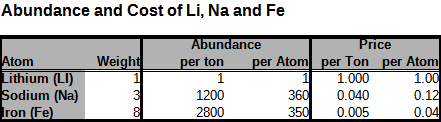
Lithium is the lightest element that is a solid, not a gas. Skipping over Beryllium, Boron and Carbon, Sodium is the next lightest solid and is on the row right below Lithium in the Periodic Table of Elements, and consequently, has almost the same chemical properties as Lithium, though a Sodium atom is 3.3 times heavier than a Lithium atom. Sodium atoms are also much more abundant and much less expensive than Lithium atoms. Both Sodium-Ion and Iron-Air batteries are in small-scale production today. See Table below (costs of elements relative to Lithium):
Transmission Lines:
The World-Wide Grid concept was put forward by Buckmister Fuller almost a century ago to as a means to enable PV to power the world, and today we have the technology to make this vison a reality10.
You might worry worry about rouge terrorist nations blowing up these UVH DC TL’s (Ultra-High Voltage Direct Current Transmission Lines), as we did the Nord Stream Gas Pipeline11. Of course, the U.S. had a good economic/business motivation: replacing inexpensive pipeline Russian Gas in Germany and other E.U. countries with three-times-the-price U.S. Liquified Natural Gas (LNG); a good, sound, profitable, long-range business plan some might argue. In Trump’s previous administration, he urged Europe to free itself from low-cost Russian gas and replace it with U.S. “Freedom Molecules”. Europe clearly needed a bit more urging to obtain its Freedom. It’s hard to place too high of a price on Freedom; I think all countries, as I personally, would be happy to pay 3 PLUS 3=6 times more for our energy if it came from “Freedom and Democracy Molecules [or Electrons or Photons]” even if it destroyed our industries and economy.
The U.S. might not, or might, who knows, be motivated to blow up electrical transmission lines connecting NY and Moscow, depending upon how the “economics” benefit a certain few people. However, there will be Thousands of UHV TL’s, and literally millions, if not billions, of electrical connections in Buckmister Fuller’s World-Wide Grid with distributed-production. When everyone has PV on their roof, you’d have to bomb the whole world.
Conclusion:
I’m not trying to win an argument nor to convince anyone that “this is the answer”. Rather, as I said in Solar Energy in a Nutshell, Solar Energy is a Steam Roller coming our way, and, in the long run, there is no stopping it.
So, the real question, to which I don’t know the answer, is why did I waste my time writing this? Perhaps just to show that, regardless of the fact that we live in a corrupt oligarchy run by evil psychopaths, some people believe that things still, somehow, progress in the right direction.
And, to first take Wilsoson’s side for a bit: it may be even worse than he implies, with the seriousness of this problem varying by location, especially distance from the equator, e.g.:
If you doesn’t live too far from the equator, e.g., in Ajijic Mexico, Matagalpa Nicaragua, or Nairobi Kenya, you can easily live year round with no need for heating or air conditioning. The worst tragedy that might befall you is having to taking a cool, not cold, shower once in awhile.
People living further from the equator, as I in South Central Indiana, have to worry about both dying of heat prostration in the Summer and freezing to death in the Winter. Here we get about 1/5th the amount of solar energy in the Winter as we do in the Summer, and we need about 5 times more energy to heat our homes in the Winter than to cool them in the Summer. Pretty big (about 5 x 5 = 25) mismatch between energy needs and solar resources. The Figure below shows my PV array today as I write (Mon 10 Nov ‘25 12:43).

My Charge Controller says I’ve received 0.3 kW-hr of energy so far today, and my 30 kW-hr Battery Bank State-of-Charge Meter did go from 98% to 99%. I am on grid, and am heating my house with my woodstove. As soon as it gets sunny again (hopefully before next March [the weather forecast says tomorrow, but who believes weather-forecasters]), a layer of water will form between the PV panels and the snow, and then the snow will slide off. (The sun came out at about 14:00, and my panels were mostly snow-free by 14:30, when I switched from Grid to PV power).
Folks even further from equator, above the Arctic Circle, don’t worry about night-time or a few cloudy days, but a whole 6 months when there is no sun, but so few people live there we’ll just ignore them for now. Do they still use seal fat? (For a Good Read I suggest Kabluna [the Inuit word for “White Man”]). I know that some people in the U.S. still use wood to heat their homes!
Oil, Coal and Natural Gas, in that order, are the 3 largest sources of energy today, accounting for 76% of total world energy usage. Limiting energy usage to Electrical Power Production, the top 4 sources in 2024 were Coal (34%), Natural Gas (22%), Hydro (14%), and PV (7%).
Hydro is probably the least expensive energy source, but worldwide, almost all of the hydro resources have been harvested; in the U.S., most harvested almost a century ago. The Hoover Dam, with the capacity of 2 Nuclear Power Plants, was completed 89 years ago; the TVA was founded 92 years ago.
I’ve visited all these countries, and would probably choose living in those countries in this order: Costa Rica, Iceland, France. On the Other-Other hand, I might choose France for their coffee and croissants for breakfast. Why would I ever choose to live in South Central Indiana, USA? Because I’m an Idiot? I didn’t really choose this place, but rather just ended up here, by Luck. I plan to move to Mexico when my adopted wolf-dog, Shadow, dies. Unfortunately, Shadow continues to become more healthy and energetic every day. My fault: several de-wormings (concoctions with Ivermectin), and 2 pounds of good raw meat a day. I can only blame myself.
At this point someone might say “Fusion, or Thorium and Breeder Fission, reactors”, to which I make two comments:
We already have a very nice Fusion Reactor safely located over 90 Million miles away with an expected service-free lifetime of about 5 Billion years; this gives us a bit of time to implement any other inexhaustible sources that might be less expensive than Solar, a plug-and-play mass-produced technology.
Why do we continue to provide $Billions, as we have for the past 3/4 of a century, to fund “hot fusion” research to replicate what happens in the Sun, but research into “cold fusion” to replicate what happens in Saturn and Jupiter is considered to be “pathological science” and cannot be funded?
The next Ice Age will begin any day (i.e., any century or millennia from) now and last for about 80,000 years. I don’t know about you, but I’m not counting on coal to keep me warm for 80,000 years.
At some point the exponential growth of PV, which has been ongoing for about 4 decades, will come to an end and flatten out: all exponentials functions eventually turn into other functions. That is a Statement of Fact.
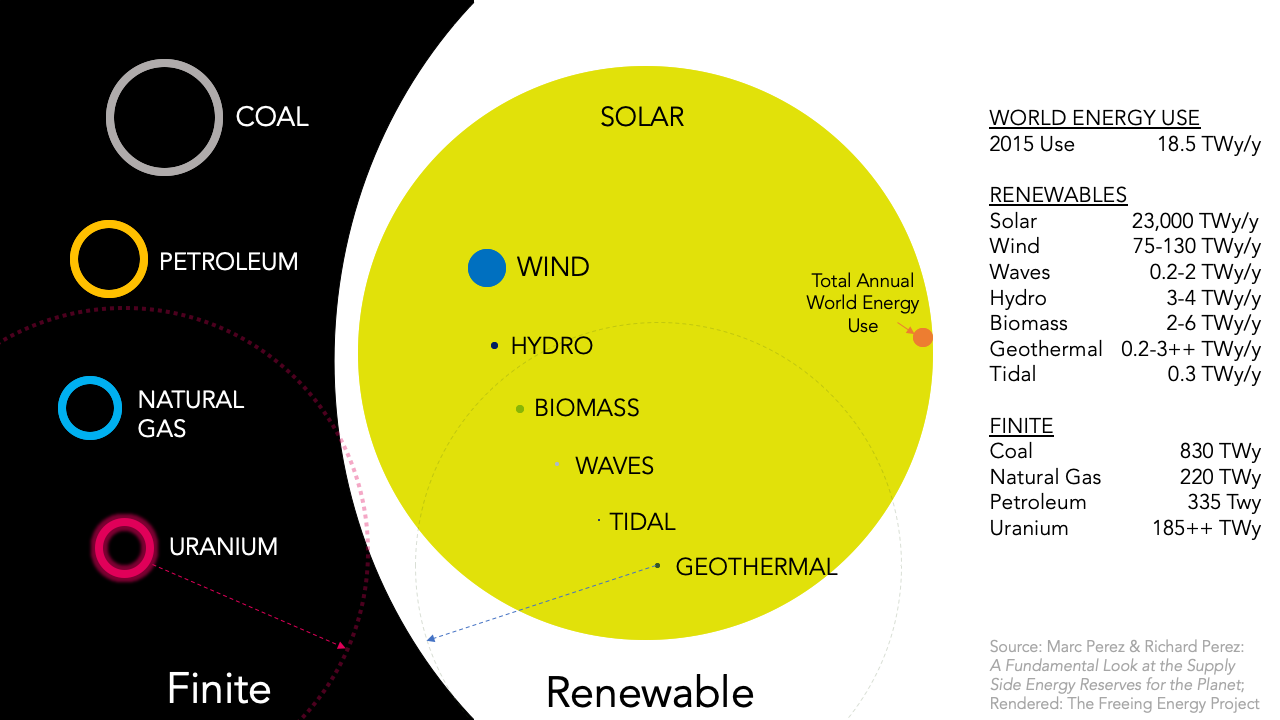
Taken from: https://www.freeingenergy.com/the-earth-gets-more-solar-energy-in-one-hour-than-the-entire-world-uses-in-a-year/. There are about 10,000 hours in a year. Wind is just a small second-order effect from Solar, so we can forget that, though in some places Wind is concentrated and very economical. Waves are a second-order effect of a second-order effect (Wind), so, we can totally forget Waves, as we can also forget Tidal, except in places such as the Bay of Fundy.
See, e.g., https://rmi.org/the-rise-of-batteries-in-six-charts-and-not-too-many-numbers/
For example, 7 years ago China commissioned the Zhundong–South Anhui UHV (Ultra High Voltage) DC (Direct Current [Edison would like that, go pound rocks Tesla!]) TL (Transmission Line), 3293 km (over 2,000 miles) long capable of transporting 12 GW (the output of about 12 Nuclear Power Plants), and in the past decade has built over 20 UHV TL’s over 1,000 km in length transporting almost 200 GW of power. See: Ultra-high-voltage-electricity-transmission-in-China. It’s only 1500 miles from Phoenix AZ to Minneapolis MN. I’m sure Chinese engineers would be happy to build a UHV TL twice as long as the Zhundong–South Anhui to connect New York City to Moscow. And someday these transmission lines will probably be superconducting.
We also have plug-and-play low cost inverters that can easily “synch” themselves to the grid for local (i.e. household) applications, taking energy from the grid when needed, and adding energy to the grid when producing excess power.
Just 1 of the 4 Nord Stream pipelines (1,200 km, or 760 miles in length) was capable of transporting 65 GW(thermal), about 40 GW(electrical). As they say, never doubt the bandwidth of a semi loaded with CD’s.
The sodium-ion battery analysis is particulary compelling. Making batteries 3.3x heavier but orders of magnitde cheaper for stationary applications is a brillant tradeoff. Your point about Buckmister Fuller's World Grid concept being technically feasible now is fascinating, and China's existing 3,300 km UHV transmission line proves its viability. The distributed generation model really does make the grid far more resilint than people realize.
Is there enough electronics grade quartz, and silver for all those solar panels?